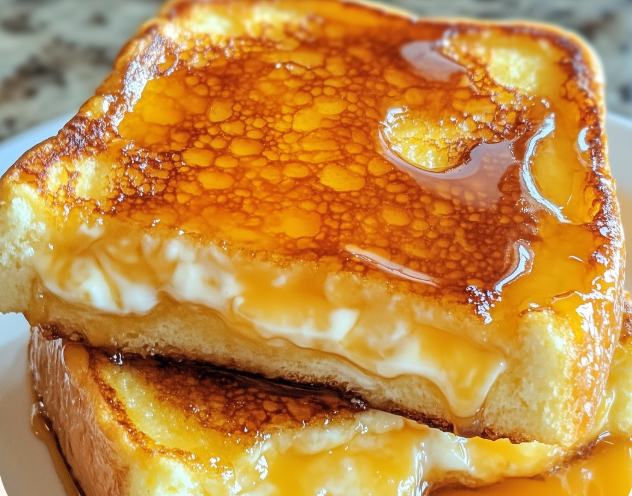
Indulgent breakfast or brunch magic: thick slices of brioche or challah soak overnight in a rich vanilla-custard, bake until just set, then get a crunchy caramelized sugar crown — basically crème brûlée for breakfast. Serve with berries, whipped cream, or a drizzle of maple syrup for total delight. ✨
Why this works
Thick, porous bread (brioche or challah) soaks up a rich custard (eggs + cream + milk + sugar + vanilla). Overnight resting lets the custard fully penetrate the bread so the interior bakes custardy, while the exterior browns. A final sprinkling of coarse sugar and a quick torch (or broiler) creates a crisp caramel shell like classic crème brûlée — contrast is everything.
Ingredients (serves 8 — adjust as needed)
Bread & soak
- 1 loaf brioche or challah (about 12–14 oz / 350–400 g), cut into 1–1½-inch thick slices (you’ll need ~10–12 slices)
- Butter for greasing pan (or nonstick spray)
Custard
- 1 cup heavy cream (240 ml)
- 1 cup whole milk (240 ml)
- 6 large eggs
- 1/2 cup granulated sugar (100 g)
- 2 teaspoons pure vanilla extract (10 ml) — or 1 vanilla bean scraped
- 1/4 teaspoon fine sea salt
- 1 tablespoon light brown sugar (optional — adds caramel depth)
- 1–2 tablespoons bourbon or dark rum (optional, adult note)
For the brûlée top & finishing
- 1/3–1/2 cup turbinado sugar or granulated sugar (for caramelizing)
- Fresh berries, whipped cream, or maple syrup to serve
Equipment
- 9×13-inch (23×33 cm) baking dish or similar shallow casserole
- Whisk and large bowl (or stand mixer)
- Fine mesh sieve (optional, for extra-smooth custard)
- Kitchen torch (preferred) — or very hot broiler / oven set to high heat
- Plastic wrap or foil for overnight
Step-by-step — Overnight method
Night before — assemble
- Grease the baking dish with butter or spray. Arrange the bread slices in a single layer, slightly overlapping (you can layer if your dish is deep — the goal is full coverage).
- In a large bowl, whisk together eggs, granulated sugar, brown sugar (if using), salt, vanilla, heavy cream, milk, and bourbon (if using) until smooth.
- Pour the custard evenly over the bread, pressing gently so slices absorb the liquid. Every slice should be moistened. Cover tightly with plastic wrap and refrigerate overnight (8–18 hours).
Morning — bake & caramelize
- Preheat oven to 175°C / 350°F. Remove plastic wrap and let the casserole sit at room temperature 15–20 minutes while the oven heats.
- If the custard pooled, gently press bread into the liquid to redistribute. For a slightly crisper finish, dot the top with a few small knobs of butter.
- Bake uncovered for 30–40 minutes (time depends on depth and bread). The center should be just set — a gentle jiggle is fine; an instant-read thermometer should read ~71–74°C / 160–165°F in the center.
- Remove from oven and let rest 5 minutes. If you like a lightly browned surface, you can broil 1–2 minutes now, watching closely.
- Sprinkle an even layer of turbinado or granulated sugar across the top — about 1 tbsp per 2–3 slices worth of surface area (adjust for your dish). Use a kitchen torch to caramelize the sugar until it forms a deep golden, crackly crust. Work in small sections and keep the flame moving. If you don’t have a torch, place under a very hot broiler (preheated to high) 2–4 minutes, watching like a hawk — sugar can burn quickly. An alternative is to place individual slices on a hot skillet with sugar, but results vary.
- Allow the caramel top to cool 2–3 minutes to harden, then serve immediately with whipped cream, berries, and/or maple syrup.
Serving & presentation ideas
- Serve warm with lightly whipped cream and fresh berries (strawberries, blueberries, raspberries).
- Drizzle high-quality maple syrup or a warm caramel sauce for extra indulgence.
- For a hotel/brunch finish, dust the edges with powdered sugar and top with a mint sprig.
- Make individual portions: assemble in shallow ramekins, refrigerate overnight, bake 20–25 minutes, then brûlée each ramekin.
Chef tips & expert touches
Chef Bobby Flay: “Use a good quality brioche — the butter-rich crumb soaks custard beautifully.”
Chef Ina Garten: “Vanilla bean makes a subtle, luxurious difference — scrape the seeds into the custard.”
Chef Gordon Ramsay: “Bake until barely set; residual heat finishes the custard — you want silky, not rubbery.”
Ree Drummond (The Pioneer Woman): “A tiny sprinkle of flaky sea salt over the brûléed sugar is heavenly — it wakes the whole dish up.”
Variations & substitutions
- Dairy-free: Use full-fat coconut milk (one can) plus a cup of almond milk to replace cream + milk. Texture will be slightly different but delicious.
- Lower-fat: Use whole milk plus 1/2 cup evaporated milk instead of some cream; expect a slightly less luxurious texture.
- Savory twist: Omit brown sugar, add a touch of grated orange zest to the custard and serve with mascarpone instead of whipped cream.
- Spiced: Add 1 tsp ground cinnamon and 1/4 tsp nutmeg to the custard for a warm autumnal note.
- Fruit-studded: Layer thin apples or pears between slices before soaking for a baked fruit-french toast.
Make-ahead, storage & reheating
- Assembled (uncooked): Refrigerate up to 18 hours before baking (best within 12 hours).
- Baked, un-brûléed: Cover and refrigerate up to 3 days. Reheat in a 160°C / 325°F oven 10–15 minutes until warm, then sprinkle sugar and torch just before serving.
- Brûléed leftovers: The caramel top softens in the fridge. Reheat gently and re-torch or broil to re-crisp sugar before serving.
Food safety & notes
- Egg safety: Eggs are fully cooked during baking; bake to reach ~71°C / 160°F in the center for safety. Use pasteurized eggs if serving folks who are extremely immunocompromised and you prefer extra caution.
- Allergens: Contains eggs and dairy; bread may contain gluten. Label for guests.
Approximate nutrition (per serving — 1/8 of casserole)
These are estimates — exact values depend on bread type, cream content, and portion size.
Troubleshooting
Custard too runny after baking
Underbaked — return to oven and bake 5–10 more minutes. Check thermometer for ~71–74°C / 160–165°F in center.
Bread soggy, not custardy
Either bread was too thin or you baked too briefly (or used very dense bread). Use thicker slices of airy brioche/challah and bake until just set. Overnight soak should be 8–12 hours; much longer can over-saturate some breads.
Sugar won’t caramelize evenly under the broiler
Broilers heat unevenly; use a torch if possible. If broiling, place the pan on the top oven rack close to the element and watch constantly — rotate the pan for even color.
Frequently Asked Questions (10 quick answers)
- Can I assemble and bake the same day? Yes — soak for at least 2–3 hours, but overnight gives the best texture.
- Is brioche necessary? No, but brioche or challah are ideal for richness and custard absorption. Day-old bread works best.
- Can I brûlée without a torch? Yes — use a hot broiler for 1–4 minutes, watching carefully. Results vary slightly.
- How long does assembled casserole keep uncooked? Up to 18 hours in the fridge; best within 12 hours.
- Can I make individual portions? Yes — use shallow ramekins and reduce bake time (~20–25 min).
- Can I freeze this? Baked (un-brûléed) slices freeze well up to 2 months. Reheat and re-torch when ready.
- What sugar is best for brûlée? Turbinado or granulated sugar both work; turbinado gives more visual texture.
- My top melted but didn’t harden — why? The sugar needs to reach a high enough temperature to re-crystallize; torch until deep amber (but not burnt) and let cool 2–3 minutes.
- Can I cut calories? Use 2% milk + 1/2 cup cream instead of all cream, and choose a lighter bread, but expect less silky richness.
- Any booze tips? A tablespoon of bourbon or orange liqueur in the custard is fantastic — aromatic and grown-up.
Related recipes & resources
- Classic Crème Brûlée — learn the technique behind the perfect caramel shell.
- Homemade Brioche — bake your own loaf for even better results.
- Maple Butter — a lovely spread to serve alongside.
Final Notes — make it your brunch signature
This Caramelized Overnight Crème Brûlée French Toast is luxurious, deceptively simple, and a total showstopper. Prep the night before, torch at the last minute, and watch guests grin when they crack that caramel top. If you want, I can scale this for a crowd, convert to individual ramekins with times, or create a printable recipe card — tell me which and I’ll format it. 🥂🍞🍮