
- 0 Facebook
- 1 Pinterest
- 0 Email
- Copy Link
- 1 share
There’s something about a bubbling, golden-topped casserole coming out of the oven on a cold winter evening that makes everyone at the table feel instantly at home. This Creamy Winter Vegetable Casserole has been a fixture at my family’s dinner table for years — it started as one of those “let’s use up the vegetables in the fridge” experiments and somehow became the dish everyone requests by name the moment November rolls around. My Aunt Anne was the one who first showed me that cauliflower, broccoli, and carrots don’t need to be complicated to be extraordinary. She taught me that a good béchamel sauce and a generous handful of cheddar can transform even the simplest vegetables into something truly nourishing and satisfying. If you’ve ever loved a cheesy cauliflower casserole or a pan of tender roasted broccoli and carrots , this recipe pulls both worlds together into one creamy, crowd-pleasing bake. I hope it finds a permanent place at your table too.
You Might Also Love
If this cozy casserole speaks to you, these recipes from my kitchen are worth a spot on your weeknight rotation too.
- Creamy Broccoli Cheddar Casserole — rich, cheesy, and perfect for feeding a hungry family any night of the week.
- Cheesy Cauliflower Casserole — velvety cheese sauce meets tender cauliflower in this comforting family favorite.
- Loaded Cauliflower Casserole — packed with hearty toppings, this one disappears fast at every gathering.
- Broccoli Potato Cheese Soup — a warming, creamy soup that pairs beautifully with crusty bread on cold nights.
Why You’ll Love This Recipe
- Velvety, golden cheese sauce. The béchamel base coats every vegetable in a rich, creamy layer — with cheddar melting into silkiness and Parmesan adding a sharp, savory depth.
- Tender vegetables with satisfying bite. Cauliflower and broccoli soften beautifully in the oven while the carrots add a gentle sweetness and a slightly firmer texture that keeps every forkful interesting.
- Warm spice notes that pull it all together. A hint of nutmeg woven into the sauce gives this casserole a subtle warmth you can’t quite put your finger on — but you’d miss it if it wasn’t there.
- A golden, crispy breadcrumb crown. The optional breadcrumb topping toasts into a crunchy contrast against the creamy filling — that textural combination is what keeps people going back for seconds.
- Nourishing comfort food at its simplest. Three wholesome winter vegetables, a handful of pantry staples, and one baking dish . The kind of recipe that feels indulgent but works hard for you.
Ingredient Notes
- Cauliflower florets — Cut into even pieces so they cook at the same rate as the broccoli.
- Broccoli florets — Smaller florets absorb the cheese sauce beautifully; avoid oversized pieces.
- Sliced carrots — Adds natural sweetness and color contrast; slice evenly for consistent tenderness.
- Butter — The fat base for the béchamel; unsalted gives you full control over seasoning.
- All-purpose flour — Thickens the sauce into a smooth, coating consistency — don’t rush this step.
- Whole milk (warm) — Warm milk prevents lumps; cold milk can seize the roux. For a loaded cauliflower casserole style richness, use full-fat.
- Shredded cheddar cheese — Sharp cheddar melts into a bold, creamy layer that coats every vegetable.
- Grated Parmesan — Adds a nutty, salty depth that balances the richness of the cheddar sauce.
- Garlic powder — Infuses savory warmth evenly throughout the sauce without overpowering.
- Ground nutmeg — A classic béchamel addition; use sparingly — it’s subtle but essential.
- Breadcrumbs (optional) — Golden and crunchy when baked; panko gives the crispiest result.
- Fresh parsley — A bright, fresh finish that lifts the richness of the finished casserole.
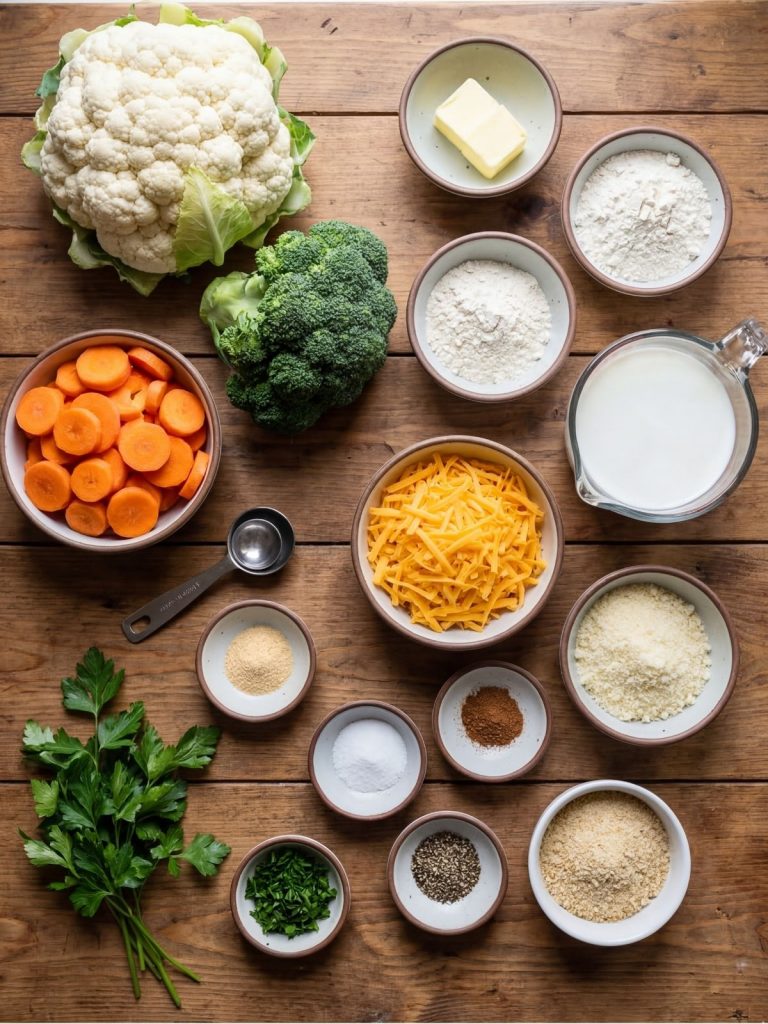
How to Make Creamy Winter Vegetable Casserole?
- Preheat the oven . Set oven to 375°F (190°C) and lightly grease a 9×13-inch baking dish .
- Blanch the vegetables. Bring a large pot of salted water to a boil; add cauliflower, broccoli, and carrots and cook for 3–4 minutes until just tender-crisp. Drain well and set aside.
- Make the roux. Melt butter in a medium saucepan over medium heat; whisk in flour and cook for 2 minutes, stirring constantly, until the mixture smells lightly nutty.
- Build the béchamel. Gradually pour in the warm milk, whisking constantly, until the sauce is smooth and thickened, about 4–5 minutes.
- Add the cheese. Remove from heat; stir in cheddar, Parmesan, garlic powder, and nutmeg until fully melted and the sauce is velvety.
- Season the sauce. Taste and adjust with salt and freshly ground black pepper to your liking.
- Combine vegetables and sauce. Arrange the drained vegetables in the prepared baking dish ; pour the cheese sauce evenly over the top and gently stir to coat.
- Add breadcrumb topping. If using, sprinkle ¼ cup breadcrumbs evenly over the surface and press gently into the sauce for a golden, crunchy finish.
- Bake until golden. Bake uncovered at 375°F for 20–25 minutes until the top is golden and the sauce is visibly bubbling around the edges.
- Rest before serving. Remove from the oven and rest for 5 minutes — the sauce will firm up slightly for cleaner portions.
- Garnish and serve. Scatter 1 tablespoon of chopped fresh parsley over the hot casserole and bring straight to the table.

Emily’s Expert Tips
- Don’t skip the blanching step. Undercooked vegetables going into the oven will stay firm even after baking — a quick 3–4 minute blanch guarantees that tender, yielding bite in every forkful.
- Warm your milk before adding it. Cold milk shocked into a hot roux can cause lumps that are hard to smooth out — warming it first makes the béchamel come together in minutes.
- Grate your own cheese. Pre-shredded cheese contains anti-caking agents that can make the sauce grainy rather than silky — freshly grated cheddar and Parmesan melt far more smoothly.
- Press the breadcrumbs lightly into the sauce. Rather than sprinkling loosely, gently press the crumbs into the top layer — they grip the sauce better and bake into a more even, crunchy crust.
- Let it rest for 5 minutes before serving. The sauce firms up slightly as it cools, making it easier to portion cleanly and allowing all those flavors to settle beautifully.
Storage Tips
- Refrigerate in an airtight container for up to four days.
- Reheat in the oven at 350°F covered with foil to retain moisture.
- Microwave individual portions in 60-second intervals, stirring between each.
- Freeze the unbaked casserole (without breadcrumbs) for up to two months.
- Thaw overnight in the refrigerator before baking; add fresh breadcrumbs just before baking.
Variations & Substitutions
- Make it gluten-free — swap all-purpose flour for a 1:1 gluten-free blend; use GF breadcrumbs.
- Go dairy-free — replace butter with vegan butter, milk with oat milk, and cheeses with dairy-free alternatives.
- Add protein — stir in shredded rotisserie chicken or white beans before baking for a heartier meal.
- Swap the vegetables — zucchini, green beans, or asparagus casserole -style asparagus work beautifully here.
- Boost the flavor — a pinch of smoked paprika or a dash of hot sauce in the cheese sauce adds welcome depth.
- Try a different cheese — Gruyère or fontina melt even silkier than cheddar; great for a more elegant presentation. Check my creamy broccoli cheddar casserole for cheese swap inspiration.
- Skip the topping — the casserole is equally good without breadcrumbs if you prefer a fully creamy finish.

What to Serve With Creamy Winter Vegetable Casserole?
- Roasted chicken thighs — hearty, golden, and a natural partner to the creamy vegetable base.
- Crusty sourdough bread — perfect for scooping up every last bit of that velvety cheese sauce.
- A simple green salad — crisp leaves and a light vinaigrette cut through the richness beautifully.
- Broccoli potato cheese soup — a warming bowl alongside this casserole makes a full, satisfying winter spread.
- Pan-seared pork chops — the savory crust on the chops complements the creamy casserole perfectly.
Frequently Asked Questions
Can I make creamy winter vegetable casserole ahead of time? Yes — assemble up to 24 hours ahead, refrigerate, and bake when ready.
Can you freeze this vegetable casserole? Freeze unbaked without breadcrumbs for up to two months; thaw overnight before baking.
How long does this casserole last in the fridge? Up to four days stored in an airtight container.
Can I use frozen vegetables instead of fresh? Yes — thaw and pat dry thoroughly before using; skip the blanching step.
What cheese works best for this casserole? Sharp cheddar gives the boldest flavor; Gruyère or fontina also melt beautifully.
Is this recipe vegetarian? Yes — it contains no meat; use vegetarian Parmesan to keep it fully vegetarian.
How do I stop the sauce from turning lumpy? Use warm milk and whisk constantly; never add cold milk to a hot roux.
- 0 Facebook
- 1 Pinterest
- 0 Email
- Copy Link
- 1 share
Creamy Winter Vegetable Casserole
Ingredients
Instructions
Preheat the oven to 375°F (190°C) and lightly grease a 9×13-inch baking dish.
Bring a large pot of salted water to a boil. Add the cauliflower, broccoli, and carrots and cook for 3–4 minutes until just tender-crisp. Drain well and set aside.
Melt the butter in a medium saucepan over medium heat. Whisk in the flour and cook for 2 minutes, stirring constantly, until the mixture smells lightly nutty.
Gradually pour in the warm milk, whisking constantly, until the sauce is smooth and thickened, about 4–5 minutes.
Remove the saucepan from heat. Stir in the cheddar, Parmesan, garlic powder, and nutmeg until fully melted and the sauce is velvety.
Taste the sauce and season with salt and freshly ground black pepper to your liking.
Arrange the drained vegetables in the prepared baking dish. Pour the cheese sauce evenly over the top and gently stir to coat all the vegetables.
If using, sprinkle ¼ cup breadcrumbs evenly over the surface and press gently into the sauce for a golden, crunchy finish.
Bake uncovered for 20–25 minutes until the top is golden and the sauce is bubbling around the edges.
Remove from the oven and rest for 5 minutes to allow the sauce to firm up slightly for cleaner portions.
Scatter 1 tablespoon of chopped fresh parsley over the casserole and serve hot.
Notes
Do not skip blanching — undercooked vegetables will stay firm even after baking; 3–4 minutes gives the perfect tender-crisp result.
Always warm your milk before adding it to the roux — cold milk can cause lumps that are difficult to smooth out.
Grate your own cheese for the smoothest sauce — pre-shredded cheese contains anti-caking agents that can make the sauce grainy.
For a gluten-free version, swap all-purpose flour for a 1:1 gluten-free blend and use gluten-free breadcrumbs.
To make ahead, assemble the casserole up to 24 hours in advance, refrigerate, and bake when ready.
Refrigerate leftovers in an airtight container for up to 4 days. Reheat in the oven at 350°F covered with foil, or microwave in 60-second intervals.
To freeze, assemble unbaked without the breadcrumb topping and freeze for up to 2 months. Thaw overnight in the refrigerator , add fresh breadcrumbs, then bake as directed.